







Tel:
+86-0511-88891902

What are you looking for?
Bulk fleece scarves are often treated as simple rectangular accessories, but large orders can fail for reasons that are easy to miss during quotation: inconsistent fabric weight, poor anti-pilling performance, distorted dimensions, rough cut edges, uneven embroidery, shade variation, incorrect carton assortments, or packaging that compresses the product and damages its retail presentation. A buyer who controls only color and logo is leaving most of the commercial risk undefined.
This playbook is designed for retailers, promotional-product distributors, sports clubs, schools, charities, winter-event operators, corporate-gift buyers, importers, and private-label brands. It explains how to convert a merchandising idea into a controlled bulk fleece scarves program, how to compare suppliers, and how to make quality decisions before money is committed to mass production. It also shows when a wider scarf wholesale supplier assortment or a coordinated neck warmer wholesale program may create more value than ordering one isolated style.
JIBIL describes its manufacturing and trading network as having more than 30 years of group experience, more than six factories, over 300 workers, production capacity exceeding 1.8 million pieces per month, exports to more than 60 countries, and cooperation with more than 1,000 customers. Those figures indicate broad scale, but buyers should still qualify the specific production route for fleece scarves, embroidery, labels, printing, packaging, testing, and the intended delivery window.
A bulk fleece scarves program should be designed around where the scarf will be sold, distributed, worn, washed, and evaluated by the end user.
The same scarf should not be specified for every channel. A low-cost stadium giveaway may prioritize high visual impact, light weight, fast distribution, and compact carton packing. A premium outdoor retailer may prioritize a dense hand feel, clean edges, anti-pilling performance, subtle branding, and retail-ready packaging. A school or corporate uniform program may prioritize color consistency, easy care, and repeat-order reliability. A charity winter campaign may prioritize warmth, simple sizing, and efficient bulk packing.
Before discussing fabric, define the business objective. Is the scarf intended to generate brand visibility, create a resale margin, complete a winter set, provide practical warmth, reward members, or support an event? Then define the expected wearing environment. A scarf used for commuting in a cold urban climate has different needs from a lightweight scarf used during a promotional run or an indoor arena event.
The use case determines which defects matter most. A promotional buyer may accept a simpler edge finish but cannot accept logo errors or late delivery. A retailer may accept a longer development process but requires stable dimensions, labeling, barcodes, shelf presentation, and consistent color across repeat orders. A sports program may need exact team colors and a scarf length suitable for visible wrapping. A hospitality or staff program may need wash durability and a color that coordinates with uniforms.
A practical sourcing brief should answer eight questions: who will use the scarf, where it will be used, how it will be sold or distributed, expected order quantity, target retail or program budget, branding method, destination market, and required delivery date. These answers allow the supplier to recommend a realistic material and construction rather than quoting a generic fleece rectangle.
Bulk fleece scarves are differentiated by fiber content, fabric weight, density, brushing, anti-pilling finish, edge construction, and the number of layers.
Polyester fleece is common because it can provide warmth, softness, color range, and efficient production. Recycled polyester may be available when the buyer requires a recycled-content program, but the claim should be supported by the appropriate documentation. The buyer should state whether certification is mandatory or whether recycled content without a specific chain-of-custody claim is acceptable.
Fabric weight is normally expressed in grams per square meter. As a practical commercial guide rather than a universal standard, fleece scarves may be grouped into approximately 180–220 g/m² for lighter promotional use, 220–280 g/m² for general winter retail, and 280–320 g/m² or more for heavier programs. A heavier number does not automatically mean better quality. Density, fiber, brushing, finish, and construction affect warmth, drape, pilling, and appearance.
Surface finish changes the product significantly. A deeply brushed surface feels plush but can show pilling or flattening if the fabric is not controlled. A shorter, cleaner pile may support sharper embroidery and a more technical appearance. Double-sided fleece can improve hand feel on both faces, while a fabric with one presentation face may require careful folding and branding placement.
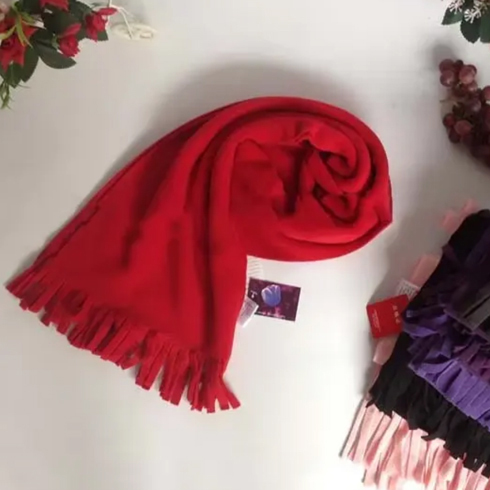
Edge construction should match the channel. Common options include straight cut, heat cut, overlock, folded and stitched, binding, fringe, or a shaped end. A simple heat-cut edge can be efficient on compatible synthetic fleece, but the buyer should inspect the feel and visual consistency. Overlock adds definition but introduces thread color and stitch-quality requirements. A folded edge can look more finished but adds labor and thickness. Fringe creates a classic scarf appearance but requires control of length, spacing, and unraveling.
Single-layer scarves are common because fleece already has body and warmth. Double-layer construction can create a premium product, hide the reverse side of embroidery, or combine colors, but it also increases weight, cost, drying time, and carton volume. Buyers should test how the scarf drapes and wraps before choosing a heavier construction.
A scenario matrix compares scarf specifications according to the business conditions that matter in each sales or distribution channel.
| Program Type | Recommended Direction | Priority Quality Points | Common Risk |
|---|---|---|---|
| Mass promotion or giveaway | Light-to-medium fleece, simple edge, bold logo, efficient bulk packing | Logo accuracy, carton quantity, delivery date, color consistency | Over-specifying packaging and increasing cost without user value |
| Retail private label | Medium or heavier fleece, clean finish, subtle branding, retail packaging | Pilling, dimensions, hand feel, barcode, care and fiber labels | Approving only one sample and missing bulk-lot variation |
| Sports club or fan merchandise | Team colors, longer visible wrap, embroidery or patch, optional fringe | Color match, logo placement, repeatability, assortment | Color differences between scarf, hat, gloves, and packaging |
| Corporate uniform | Controlled color, easy-care fabric, simple branding, repeat-order plan | Wash stability, shade continuity, professional appearance | No retained standard for future replenishment |
| Outdoor or winter program | Denser fleece, functional dimensions, low-bulk seams, optional set | Warmth, pilling, abrasion, comfort, packaging compression recovery | Choosing weight without testing real-use comfort |
| Charity or emergency distribution | Practical warmth, simple universal format, bulk packing | Quantity accuracy, basic durability, clean production, delivery reliability | Complex customization delaying distribution |
The matrix prevents buyers from paying for features that do not support the program. A sophisticated box may help a premium retail product but create unnecessary cost and waste for a giveaway. A dense embroidery logo may reinforce a fashion brand but make a lightweight scarf stiff. A long scarf may improve visual merchandising but increase material consumption and carton volume.
Use the scenario to prioritize requirements. Divide specifications into three levels: mandatory, preferred, and optional. Mandatory requirements control safety, function, market compliance, brand accuracy, and delivery. Preferred requirements improve value but may be adjusted if they conflict with cost or timing. Optional requirements can be removed without damaging the program. This structure makes supplier discussions faster and reduces late-stage changes.
Bulk fleece scarves are produced through fabric sourcing or knitting, dyeing, finishing, inspection, spreading, cutting, edge treatment, decoration, labeling, final inspection, and packing.
Material approval is the first control point. The buyer should approve composition, weight, color, width, surface, stretch, and hand feel. If a physical sample is approved, the factory should retain a signed or sealed reference. Bulk fabric should be checked before cutting because defects found after decoration are more expensive to correct.
Spreading and cutting influence dimensions and edge quality. Fabric tension during spreading can cause pieces to relax to different lengths. A blunt blade or unsuitable heat-cut setting can create rough, uneven, or melted edges. The buyer should define finished dimensions and tolerance, and the factory should measure pieces after they have relaxed.
Edge finishing creates another defect zone. Overlock stitches can skip, wave, tighten, or use the wrong thread shade. Fringe can vary in length or density. Folded edges can twist if the seam allowance is inconsistent. Binding can pucker or appear wavy. A visual standard should show the approved edge from both sides.
Decoration can distort the fabric. Embroidery may pull or compress fleece, especially when the design is dense. Stabilizer selection, hoop tension, stitch density, and logo placement affect the result. Heat transfers may sit unevenly on a raised surface or show adhesion problems. Patches may curl at the corners. Buyers should approve decoration on the exact fleece and after the intended wash test.
Labels and packaging are frequent sources of avoidable errors. Fiber content, country of origin, care information, size, barcode, and brand details must match the approved file and destination requirements. Packing teams need a clear assortment plan. If multiple colors or designs are ordered, the carton marking should show the contents accurately. Retail packaging should be tested after normal handling and carton compression.
A quality-control plan defines what will be checked, when it will be checked, how it will be measured, and what happens if the result is outside the agreed requirement.
Start with incoming fabric inspection. Check roll identification, shade lot, width, weight, surface defects, contamination, and hand feel. When color accuracy is critical, compare bulk fabric with the approved standard under controlled lighting. Keep shade lots separated during cutting and packing unless the buyer approves mixing.
Inline inspection should occur after the first production units are complete but before most of the order is decorated. Measure length, width, edge finish, logo position, and packaging concept. This stage is valuable because process settings can still be corrected. Waiting until final inspection may reveal a repeat defect across the entire order.
Final inspection should use an agreed sampling plan. ISO 2859-1 is widely used as a framework for inspection by attributes. Many consumer-goods buyers discuss AQL 2.5 for major defects and 4.0 for minor defects as a starting point, but the correct levels depend on product risk and buyer policy. The order document should define critical, major, and minor defects rather than leaving inspectors to guess.
| Inspection Category | Examples | Suggested Control Method |
|---|---|---|
| Material | Wrong composition, weight outside tolerance, shade difference, surface contamination | Incoming roll checks, approved swatch, test report where required |
| Dimensions | Length or width outside tolerance, uneven ends, distortion | Measure laid flat after conditioning using the agreed method |
| Appearance | Pilling, brushing variation, holes, stains, visible defects | Visual inspection under consistent lighting and defined distance |
| Edge | Skipped stitches, rough heat cut, uneven fringe, waving | Compare with golden sample and seam standard |
| Branding | Wrong logo, incorrect size, poor placement, puckering, lifting | Artwork overlay, measurement, wash or adhesion test |
| Labels | Wrong fiber content, care symbols, country, barcode, spelling | Approved print file and barcode scan |
| Packing | Wrong quantity, color mix, damaged bag, incorrect carton mark | Carton assortment check, drop/handling review where relevant |
Pilling should be treated as a measurable requirement when the product is positioned for repeated use. ISO 12945-2 describes a modified Martindale method for evaluating pilling, fuzzing, or matting. The buyer and laboratory should agree the cycle point and acceptance grade. The phrase “anti-pilling fleece” is not enough by itself because different suppliers may use different internal meanings.
Abrasion may also matter for scarves used with uniforms, backpacks, outdoor equipment, or repeated retail use. ISO 12947-2 covers determination of fabric breakdown using the Martindale method. Not every scarf needs a demanding abrasion requirement, but a buyer should consider it when the product will experience regular friction.
Color control is the process of defining an approved reference, managing dye lots, and checking how the color appears across different materials and lighting conditions.
A digital screen is not a reliable final color standard. Buyers should use a Pantone reference, lab dip, yarn card, or approved physical sample and identify which reference takes priority. For custom dyeing, approve lab dips before bulk production. For stock fabric, approve an actual cutting from the available lot.
Fleece surface texture changes perceived color. Brushed fibers reflect light differently depending on direction, pressure, and viewing angle. A scarf may look lighter when the pile is moved. Heather and mélange effects create additional variation. Buyers should inspect the product in the orientation it will be displayed and should avoid using an unrealistic zero-tolerance expectation.
Coordinated sets require separate approvals. The same color code can look different on polyester fleece, acrylic knit, embroidery thread, woven labels, plastic packaging, and printed paper. The goal is a harmonious set, not necessarily an impossible identical spectral match across every substrate. A master color board containing all approved components is useful for factory and buyer review.
Repeat orders need continuity planning. Ask whether the supplier can retain fabric or yarn references, production records, and approved samples. If a new dye lot is required, the buyer should expect a new approval. Using stock colors may improve repeatability and lead time, but availability should be confirmed before the sales season.
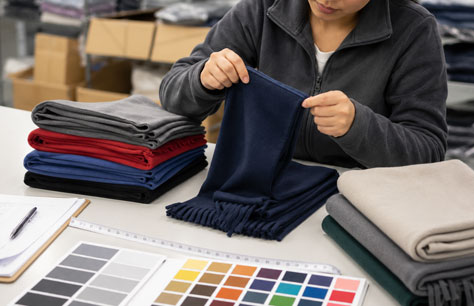
Branding and packaging convert a functional fleece scarf into a retail, promotional, or uniform product with a defined identity and distribution format.
Embroidery is durable and familiar, but the design should be optimized for fleece. Use a size and stitch density that remain readable without creating a rigid patch. Test the reverse side for comfort when the logo may touch the neck or face. Position the logo according to how the scarf is worn, not only how it lies flat on a table.
Woven labels provide fine detail and consistent appearance. They can be sewn into the edge, folded around the end, or applied as a patch. Define label fold, dimensions, position, stitch color, and orientation. A label near the end of a long scarf may remain visible when wrapped, while a central label may disappear.
Printed or transfer methods can support larger graphics, but fleece surface must be tested. Sublimation can work on suitable polyester material and may be useful for broad color areas. Heat transfers can reproduce detail but require adhesion and migration checks. Screen printing may suit simple graphics on compatible surfaces. The buyer should compare hand feel and flexibility after application.
Retail packaging options include belly bands, hangtags, hooks, folded sleeves, bags, boxes, and bundled sets. Packaging should protect the product, communicate required information, and fit the channel. It should also use carton space efficiently. A bulky box can increase freight and storage cost more than expected.
Promotional orders often benefit from simplified bulk packing. Scarves can be folded in counted bundles with a master carton label, provided the distribution method does not require individual packaging. For event kits, consider pre-packing scarves with hats, gloves, tickets, or information cards. The supplier needs exact kit ratios and packing diagrams.
Bulk fleece scarves price is shaped by fabric consumption, material quality, finishing, decoration, order complexity, testing, packaging, and logistics.
Dimensions directly affect fabric use. A longer or wider scarf may improve warmth and styling but increases material and carton volume. Buyers should evaluate a physical mockup before choosing dimensions from a competitor product. Even small changes become significant across thousands of units.
Fabric weight and finish affect both direct cost and perceived value. Recycled certified material may involve different minimums and documentation. Custom colors can require dye-lot commitments. Stock colors may reduce risk but limit brand precision. Anti-pilling finish, double-sided brushing, or specialty surface treatments can add cost and testing needs.
Decoration cost depends on setup and run complexity. Embroidery is influenced by stitch count, size, number of positions, and backing. Woven labels have setup and quantity considerations. Printed graphics depend on coverage, colors, repeat, and material compatibility. A buyer should compare at least two decoration routes on the actual fabric.
Order fragmentation increases cost. Ten colors at low quantity each can be more expensive and risky than two high-volume colors. Multiple barcodes, size labels, packaging languages, and carton assortments add labor and error potential. Consolidating core elements can preserve brand value while improving production stability.
Landed cost should include unit price, testing, inspection, packaging, inland transport, export handling, freight, duty, warehousing, and rework risk. Compare suppliers using the same incoterm and product specification. A low quote based on lighter fabric or smaller dimensions is not a valid comparison.
A sourcing playbook creates a repeatable order process that reduces missed requirements and late-stage corrections.
Define the program: Record channel, end user, climate, distribution method, quantity, budget, and delivery date.
Create the specification: Set composition, weight, dimensions, color, edge, branding, labels, packaging, and tests.
Request comparable quotations: Give every supplier the same brief and require assumptions to be listed.
Approve material: Review swatches, weight, hand feel, shade, and documentation before full samples.
Approve prototype: Check dimensions, drape, edge, logo, comfort, and appearance when worn.
Run relevant tests: Select pilling, wash, rubbing, abrasion, dimensional stability, or chemical tests according to market and use.
Freeze the pre-production standard: Sign the final sample and issue one controlled production file.
Inspect inline: Confirm early units before most decoration and packing are completed.
Inspect final goods: Use the agreed sampling plan and verify packing, barcodes, and carton marks.
Review the program: Record returns, user feedback, sell-through, and production lessons for replenishment.
The review step is often ignored. A buyer should compare the finished product with the approved sample after transport and storage. Note compression recovery, packaging damage, color feedback, pilling complaints, sizing comments, and barcode errors. This information improves the next order and creates a stronger supplier relationship.
JIBIL can support fleece scarf development through material selection, customization, sample development, production coordination, quality control, packaging, and global export service.
The most effective way to work with JIBIL is to send a complete request rather than asking only for a price. Include quantity, dimensions, desired fabric weight, color references, logo artwork, branding method, packaging, destination, tests, and delivery date. If the program includes matching beanies, gloves, neck warmers, or other scarves, identify the shared design elements and the products that require separate performance standards.
Ask JIBIL to propose alternatives where useful. A lighter fleece may suit a promotion, while a denser anti-pilling option may suit retail. A woven label may create better comfort than dense embroidery. Bulk packing may reduce cost for an event, while a belly band may be enough for retail without the volume of a box. A supplier adds value when it explains these trade-offs before sample approval.
Buyers should request the actual factory and process information relevant to the order. Verify which site handles cutting and sewing, which partner handles embroidery or printing, how fabric lots are controlled, and which certificates apply. Retain the approved sample and specification for repeat orders.
This FAQ answers common sourcing questions about fleece scarf weight, pilling, sizing, branding, testing, and wholesale order planning.
There is no single correct weight. Light promotional scarves may use approximately 180–220 g/m² fleece, general winter retail may use around 220–280 g/m², and heavier programs may use 280–320 g/m² or more. These are commercial planning bands, not universal standards. Density, brushing, fiber, dimensions, and construction also affect warmth, drape, and perceived quality.
Approve production-intent fabric and define a test method, cycle point, and acceptance grade. ISO 12945-2 provides a recognized modified Martindale method for evaluating pilling, fuzzing, or matting. Buyers should also inspect surface consistency before cutting and test the finished decorated scarf after washing, because embroidery, seams, and packaging friction can affect appearance.
Embroidery works well for simple premium logos, woven labels support fine detail and light hand feel, patches create a distinct brand element, and compatible print or transfer methods can support larger graphics. The best method depends on artwork, fleece surface, order quantity, budget, wash requirement, and where the logo should remain visible when the scarf is worn.
Dimensions depend on adult or child use, wrapping style, climate, retail positioning, and material weight. Buyers should test a physical sample rather than copy a generic size. The purchase order should define finished length and width, measurement method, and tolerance. Fringe or folded ends should be included clearly in the dimension definition.
Yes, suitable recycled polyester fleece can be used. Buyers should clarify whether they need a simple recycled-content material declaration or a certified chain-of-custody claim. When certification is required, verify the scope certificate, production site, transaction documentation, and labeling language. Material availability, color, minimum lot, and lead time may differ from standard polyester.
Check quantity, color assortment, dimensions, weight, surface, pilling appearance, edge finish, logo, labels, barcodes, packaging, carton marks, and destination documents. Use an agreed sampling plan and compare goods with the approved sample. Open packed cartons to verify compression recovery and scan a sample of retail barcodes before shipment.
The following external sources provide additional information on abrasion, pilling, and recycled-material chain-of-custody standards:
Bulk fleece scarves are commercially successful when the product specification reflects the actual channel and use case. Retail, promotional, uniform, sports, outdoor, and charity programs require different balances of weight, finish, branding, packaging, testing, and price. Treating every order as the same rectangular product creates avoidable defects and unnecessary cost.
The strongest procurement process begins with a clear brief, comparable quotations, production-intent material approval, measurable quality requirements, controlled samples, inline checks, and final inspection. Buyers should compare landed value rather than unit price alone and should preserve approved standards for replenishment. JIBIL can support custom fleece scarf and coordinated winter-accessory programs, but the quality of the result depends on the quality of the specification. Send the intended use, quantity, dimensions, material direction, artwork, packaging, destination, test requirements, and target delivery date to receive a more accurate and actionable proposal.